底层原因

react 渲染的时候,虚拟dom,也就是 fiber 节点并不会删除,而是先存储到一个 map 结构里面,在渲染同级节点的时候看有没有复用,然后删除定义的 map 中对应 key 的值。最终还存储在 map 里的节点直接在 浏览器dom 中删除。下面是部分源码。

1
2
3
4
5
6
7
8
9
10
11
12
13
14
15
16
17
18
19
20
21
22
23
24
25
26
27
28
29
30
31
32
33
34
35
36
37
38
39
40
41
42
43
44
45
46
47
48
49
50
51
52
53
54
55
56
57
58
59
60
61
62
63
64
65
66
67
68
69
70
71
72
73
74
75
76
77
78
79
80
81
82
83
84
85
86
87
88
89
90
91
92
93
94
95
96
97
98
99
100
101
102
103
104
105
106
107
108
109
110
111
112
113
114
115
116
117
118
119
120
121
122
123
124
125
126
127
128
129
130
131
132
133
134
135
136
137
138
139
140
141
142
143
144
145
146
147
148
149
150
151
152
153
154
155
156
157
158
159
160
161
162
163
164
165
166
167
168
169
170
171
172
173
174
175
176
177
178
179
180
181
182
183
184
185
186
187
188
189
190
191
192
193
194
195
196
197
198
199
200
201
202
203
204
205
206
207
208
209
210
211
212
213
214
215
216
217
218
219
220
221
222
223
224
225
226
227
228
function mapRemainingChildren(
currentFirstChild: Fiber,
): Map<string | number | ReactOptimisticKey, Fiber> {
// Add the remaining children to a temporary map so that we can find them by
// keys quickly. Implicit (null) keys get added to this set with their index
// instead.
const existingChildren: Map<
| string
| number
// This type is only here for the case when enableOptimisticKey is disabled.
// Remove it after it ships.
| ReactOptimisticKey,
Fiber,
> = new Map();

let existingChild: null | Fiber = currentFirstChild;
while (existingChild !== null) {
if (existingChild.key === null) {
existingChildren.set(existingChild.index, existingChild);
} else if (
enableOptimisticKey &&
existingChild.key === REACT_OPTIMISTIC_KEY
) {
// For optimistic keys, we store the negative index (minus one) to differentiate
// them from the regular indices. We'll look this up regardless of what the new
// key is, if there's no other match.
existingChildren.set(-existingChild.index - 1, existingChild);
} else {
existingChildren.set(existingChild.key, existingChild);
}
existingChild = existingChild.sibling;
}
return existingChildren;
}

function reconcileChildrenArray(
returnFiber: Fiber,
currentFirstChild: Fiber | null,
newChildren: Array<any>,
lanes: Lanes,
): Fiber | null {
// This algorithm can't optimize by searching from both ends since we
// don't have backpointers on fibers. I'm trying to see how far we can get
// with that model. If it ends up not being worth the tradeoffs, we can
// add it later.

// Even with a two ended optimization, we'd want to optimize for the case
// where there are few changes and brute force the comparison instead of
// going for the Map. It'd like to explore hitting that path first in
// forward-only mode and only go for the Map once we notice that we need
// lots of look ahead. This doesn't handle reversal as well as two ended
// search but that's unusual. Besides, for the two ended optimization to
// work on Iterables, we'd need to copy the whole set.

// In this first iteration, we'll just live with hitting the bad case
// (adding everything to a Map) in for every insert/move.

// If you change this code, also update reconcileChildrenIterator() which
// uses the same algorithm.

let knownKeys: Set<string> | null = null;

let resultingFirstChild: Fiber | null = null;
let previousNewFiber: Fiber | null = null;

let oldFiber = currentFirstChild;
let lastPlacedIndex = 0;
let newIdx = 0;
let nextOldFiber = null;
for (; oldFiber !== null && newIdx < newChildren.length; newIdx++) {
if (oldFiber.index > newIdx) {
nextOldFiber = oldFiber;
oldFiber = null;
} else {
nextOldFiber = oldFiber.sibling;
}
const newFiber = updateSlot(
returnFiber,
oldFiber,
newChildren[newIdx],
lanes,
);
if (newFiber === null) {
// TODO: This breaks on empty slots like null children. That's
// unfortunate because it triggers the slow path all the time. We need
// a better way to communicate whether this was a miss or null,
// boolean, undefined, etc.
if (oldFiber === null) {
oldFiber = nextOldFiber;
}
break;
}

if (__DEV__) {
knownKeys = warnOnInvalidKey(
returnFiber,
newFiber,
newChildren[newIdx],
knownKeys,
);
}

if (shouldTrackSideEffects) {
if (oldFiber && newFiber.alternate === null) {
// 命中了这个位置的“槽位”,但没复用旧 fiber
// 所以我们需要删除旧的child
deleteChild(returnFiber, oldFiber);
}
}
lastPlacedIndex = placeChild(newFiber, lastPlacedIndex, newIdx);
if (previousNewFiber === null) {
// TODO: Move out of the loop. This only happens for the first run.
resultingFirstChild = newFiber;
} else {
// TODO: Defer siblings if we're not at the right index for this slot.
// I.e. if we had null values before, then we want to defer this
// for each null value. However, we also don't want to call updateSlot
// with the previous one.
previousNewFiber.sibling = newFiber;
}
previousNewFiber = newFiber;
oldFiber = nextOldFiber;
}

if (newIdx === newChildren.length) {
// We've reached the end of the new children. We can delete the rest.
deleteRemainingChildren(returnFiber, oldFiber);
if (getIsHydrating()) {
const numberOfForks = newIdx;
pushTreeFork(returnFiber, numberOfForks);
}
return resultingFirstChild;
}

if (oldFiber === null) {
// If we don't have any more existing children we can choose a fast path
// since the rest will all be insertions.
for (; newIdx < newChildren.length; newIdx++) {
const newFiber = createChild(returnFiber, newChildren[newIdx], lanes);
if (newFiber === null) {
continue;
}
if (__DEV__) {
knownKeys = warnOnInvalidKey(
returnFiber,
newFiber,
newChildren[newIdx],
knownKeys,
);
}
lastPlacedIndex = placeChild(newFiber, lastPlacedIndex, newIdx);
if (previousNewFiber === null) {
// TODO: Move out of the loop. This only happens for the first run.
resultingFirstChild = newFiber;
} else {
previousNewFiber.sibling = newFiber;
}
previousNewFiber = newFiber;
}
if (getIsHydrating()) {
const numberOfForks = newIdx;
pushTreeFork(returnFiber, numberOfForks);
}
return resultingFirstChild;
}

// Add all children to a key map for quick lookups.
const existingChildren = mapRemainingChildren(oldFiber);

// Keep scanning and use the map to restore deleted items as moves.
for (; newIdx < newChildren.length; newIdx++) {
const newFiber = updateFromMap(
existingChildren,
returnFiber,
newIdx,
newChildren[newIdx],
lanes,
);
if (newFiber !== null) {
if (__DEV__) {
knownKeys = warnOnInvalidKey(
returnFiber,
newFiber,
newChildren[newIdx],
knownKeys,
);
}
if (shouldTrackSideEffects) {
const currentFiber = newFiber.alternate;
if (currentFiber !== null) {
// The new fiber is a work in progress, but if there exists a
// current, that means that we reused the fiber. We need to delete
// it from the child list so that we don't add it to the deletion
// list.
if (
enableOptimisticKey &&
currentFiber.key === REACT_OPTIMISTIC_KEY
) {
existingChildren.delete(-newIdx - 1);
} else {
existingChildren.delete(
currentFiber.key === null ? newIdx : currentFiber.key,
);
}
}
}
lastPlacedIndex = placeChild(newFiber, lastPlacedIndex, newIdx);
if (previousNewFiber === null) {
resultingFirstChild = newFiber;
} else {
previousNewFiber.sibling = newFiber;
}
previousNewFiber = newFiber;
}
}

if (shouldTrackSideEffects) {
// Any existing children that weren't consumed above were deleted. We need
// to add them to the deletion list.
existingChildren.forEach(child => deleteChild(returnFiber, child));
}

if (getIsHydrating()) {
const numberOfForks = newIdx;
pushTreeFork(returnFiber, numberOfForks);
}
return resultingFirstChild;
}

整体思路基本上就是我上面所说,我再次将上面的代码总结为一句话
用 mapRemainingChildren 把剩余旧节点放进 existingChildren (key → oldFiber),遍历新 children 时通过 key/index 找到可复用的旧 fiber 并从 Map 中删除,最后对 Map 中仍然存在的旧 fiber 调用 deleteChild,实现“根据 key 对比后删除多余旧节点”的逻辑。

索引作为key会发生什么呢

案例1

1
2
3
4
5
6
7
8
9
10
11
12
13
14
15
16
17
18
19
function App() {

const [arr, setArr] = useState([
'one', 'two', 'three'
]);
return (
<div className="App" >
<div>

{
arr.map((item, index) => {
return <div key={index}>{item}</div>
})
}
</div>
<button onClick={() => { setArr(['two', 'three', 'one']) }}>更改</button>
</div>
);
}

渲染如图
img1

更改后会如何呢
img2

没有什么问题,那么什么情况下会出现变化呢
我们更改一下代码

案例2

1
2
3
4
5
6
7
8
9
10
11
12
13
14
15
16
17
18
19
20
21
22
23
24
25
26
27
28
29
30
31
32
33
34
35
36
37
38
39
40
41
42
43
44
45
46
47
48
49
50
51
52
53
function App() {

const [items, setItems] = useState(initialItems);

const shuffle = () => {
// 简单用反转来模拟“顺序变化”
setItems((prev) => [...prev].reverse());
};

return (
<div className="App" style={{ padding: 20 }}>
<h1>key 的设计示例</h1>

<h2>错误示例:使用 index 作为 key</h2>
<p>
在 A 这一行的输入框中输入内容,然后点击「打乱顺序」,
你会看到输入的内容跑到了别的字母上。
</p>
{items.map((item, index) => (
<div key={index} style={{ marginBottom: 8 }}>
<span style={{ display: 'inline-block', width: 20 }}>{item.label}:</span>
{/* 不受 React 控制的 input,用来暴露 DOM 复用的问题 */}
<input placeholder={` ${item.label} 输入点内容`} />
</div>
))}

<hr style={{ margin: '24px 0' }} />

<h2>正确示例:使用 id 作为 key</h2>
<p>
在 A 那一行输入内容,再点「打乱顺序」,你会看到这一行整体移动,
输入的内容会跟着 A 这一项一起移动。
</p>
{items.map((item) => (
<div key={item.id} style={{ marginBottom: 8 }}>
<span style={{ display: 'inline-block', width: 20 }}>{item.label}:</span>
<input placeholder={` ${item.label} 输入点内容`} />
</div>
))}

<button
onClick={shuffle}
style={{
marginTop: 24,
padding: '6px 12px',
cursor: 'pointer',
}}
>
打乱顺序
</button>
</div>
);
}

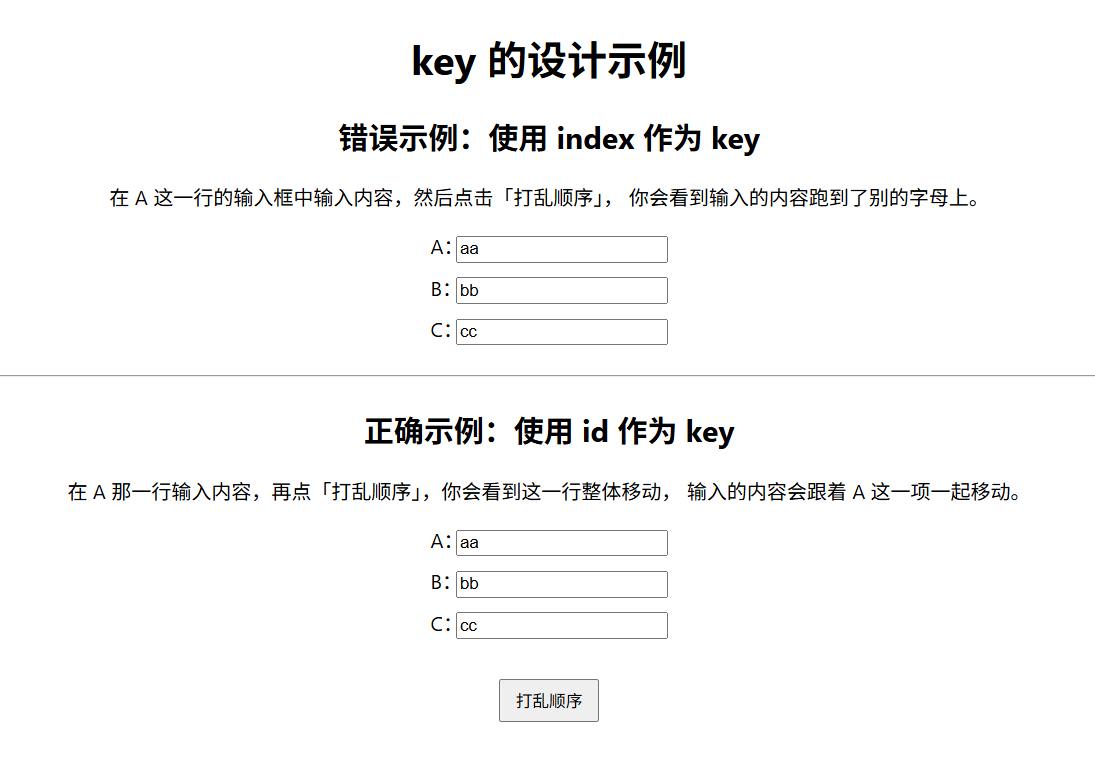
页面如下

img3

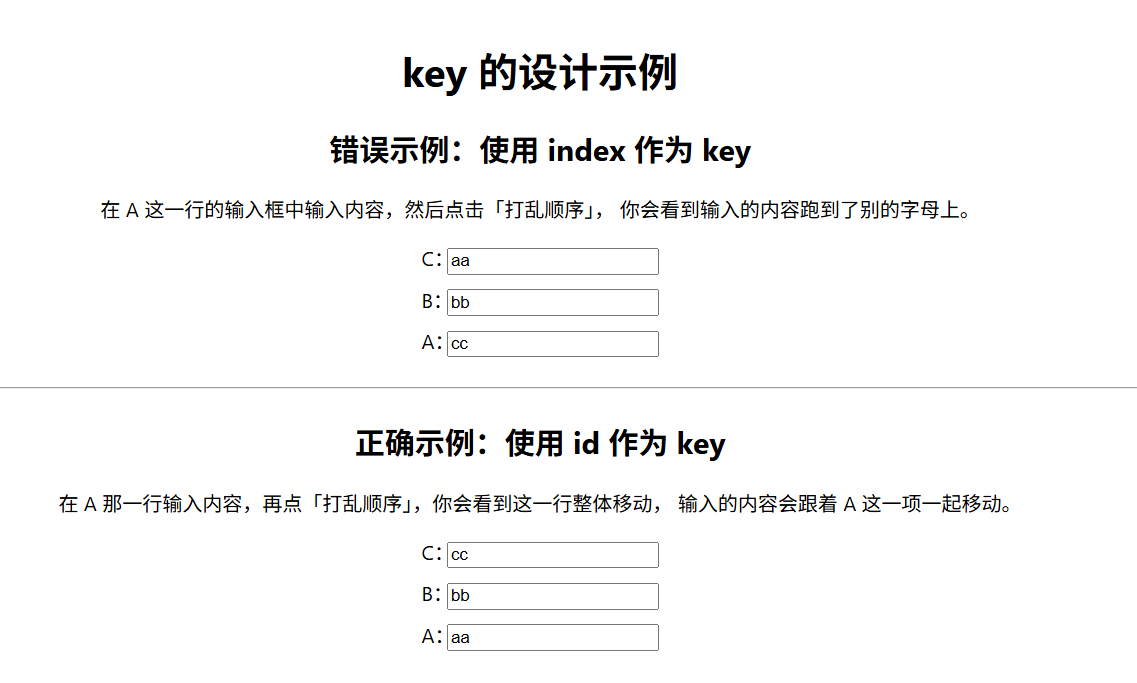
反转后页面如下

img4

现在可以明显看出区别,使用 index 会导致文本text会更改,但是dom还是会复用。这也解释了为什么上一个例子使用 index 但是区别不大。看似没有复用,但实际上还是复用了节点,React 看到 key 还是 012,就会认为「第 0 个旧节点」 = 「第 0 个新节点」,只是内容从 one 变成了 two。